“Oyyyyy Tommy Tommy.” That is the subject line Edward Andrew Weinhaus, a lawyer and a grown-up, chose for a LinkedIn message: his own spelling of the chant Tommy Robinson’s supporters raised outside the Old Bailey, some of them over an early can of Stella. Then he composes himself for the disclaimer: “Conflicts and rules prevent me from offering you any services .” The rest of the message is what he offers instead.
He mentions his representation of “controversial UK free speech advocate Tommy Robinson” and divides the world into two teams: “Tommy is often lambasted for his views! And boy does that cause the meek to back away. But not the patriots!” He signs off as “Coach” and then, for an encore:
“PS OYYYY TOMMY TOMMY !”
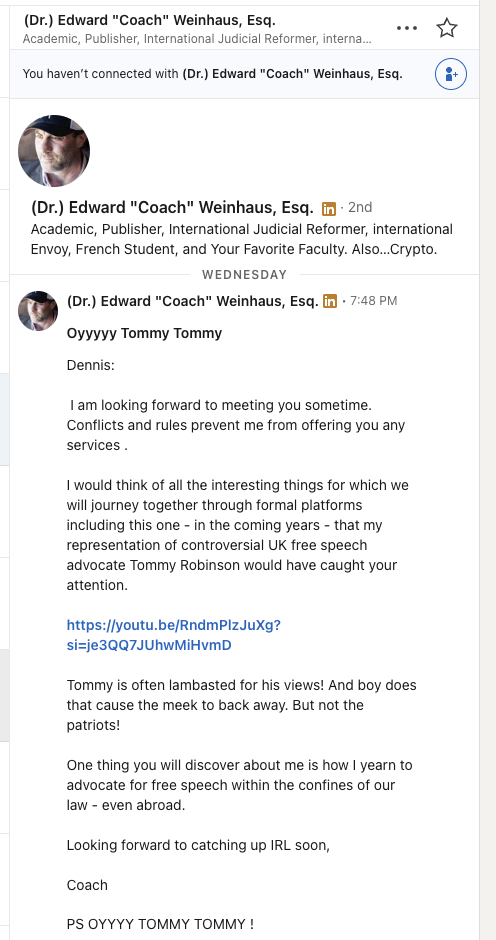
The name on the account is (Dr.) Edward “Coach” Weinhaus, Esq., a title at each end, the nickname wedged in the middle, the doctorate in parentheses. Under it: “Academic, Publisher, International Judicial Reformer, international Envoy, French Student, and Your Favorite Faculty. Also...Crypto.”
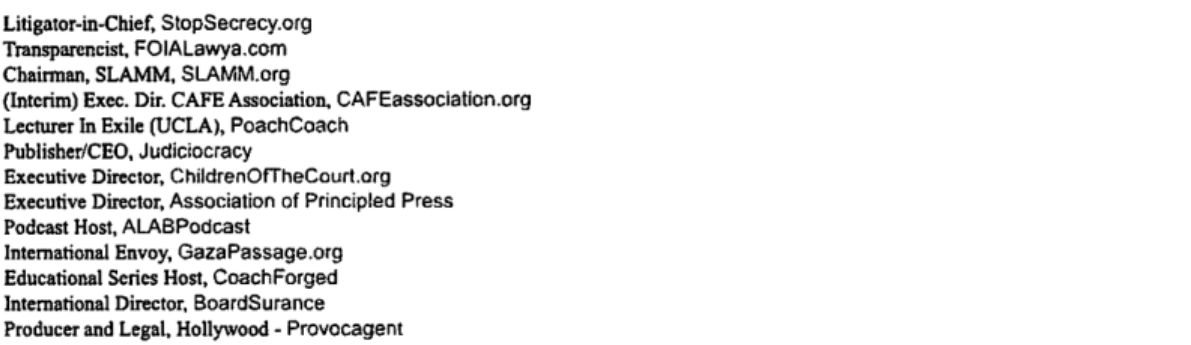
His email signature runs to thirteen titles, among them “Litigator-in-Chief,” “Transparencist” and “Executive Director, Association of Principled Press.” And the last: “Producer and Legal, Hollywood - Provocagent.”
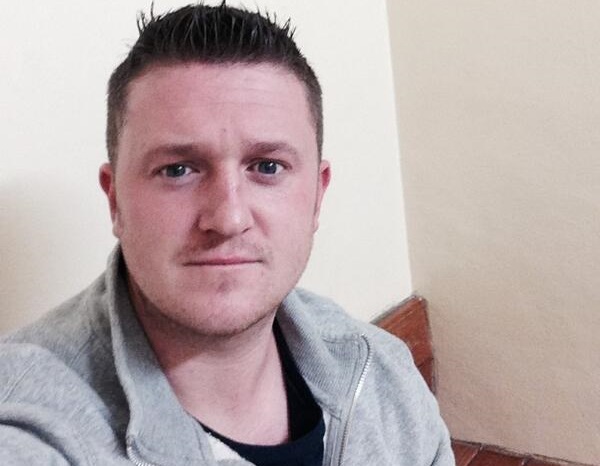
23 January 2014.Twitter, via IBTimes · Enlarge
The person Weinhaus celebrates is a convicted mortgage fraudster. In January 2014 he received eighteen months in prison after pleading guilty to two counts. Judge Andrew Bright QC called him the “instigator, if not the architect” of some of the frauds. Robinson’s response to the sentence was “This is a complete stitch-up.” The guilty pleas were his.
Robinson’s admirers were sending more than encouragement. He told the High Court in 2022 that he had spent about £100,000 gambling and wasted money on “drink, alcohol, partying” while receiving thousands of pounds in supporters’ donations.
Weinhaus makes a promise: “One thing you will discover about me is how I yearn to advocate for free speech within the confines of our law - even abroad.” The message links to a video of him abroad, at Robinson’s Unite the Kingdom rally in London on May 16, 2026.
Asked about the “far-right” label, he fixes it: “Far right is probably better replaced with very right as opposed to very wrong.” Asked about the speakers Britain had barred, he applauds its capacity to keep people out: “Very, very capable. Let it always be so.”
In The Independent’s 2019 report, Weinhaus’s “very right” man appears on video calling a taxi driver in Bologna a “little Paki” and singing about punching someone in the head and kicking him in the face, because he was “king of the whole Islam race.”
The clips, he said, came from a group chat with friends of different ethnicities who were “bantering each other constantly.” The Sun, he added, had cut them together. And he had been “absolutely steamboated.” Three excuses, and not one of them is that he didn’t say it.
Sober, he has a vocabulary. The day before Weinhaus turned up at the rally, Byline Times published an analysis of more than 140 of Robinson’s posts. White people are “natives.” Non-white people are “invaders.” Africans and Somalis keep showing up as criminals and threats.
Robinson has complained on social media about “the mindset of some black people.”
Over riot footage from The Hague he writes, “Millions of parasites that care nothing of our nations, openly show it, destroying the lives of natives,” and the cure is “Remigration and de-islamisation.” A week later the target is “invaders and their offspring,” and the cure is the same. Offspring. Byline found no Irish “invaders” in the sample, no Polish ones, no American ones. Some of his anti-Black posts have no Muslim angle at all.
In August 2025, Olajuwon Ayeni, a Black musician from Redcar, and his brother were filmed playing in a park with the family’s white granddaughters. His wife, Natalie, posted the video on TikTok. Robinson shared it with his 1.4 million followers, and the family became the target of racist abuse and threats. Two men passed the couple on the way home from the shops, spun round and threatened to “slash you up.” Ayeni’s management suspended him. “I feel I have to sleep with one eye open,” he said.
The family asked for the post to come down. Robinson left it up. “We’re a normal family who went to the park with our grandchildren,” Natalie said.
He had done this before. In October 2018 a fifteen-year-old at a school in Huddersfield, a Muslim boy who had come to Britain as a refugee from Syria and had been bullied there for two years, was grabbed by the throat on the playing field, forced to the ground and had water poured over his face. His arm was in a cast. Another pupil filmed it. The clip went viral, and the country took the refugee’s side.
Robinson had a theory about why: “cause he’s Syrian, cause he’s a refugee and cause the young kid was white and English.” His contribution, in two Facebook videos to more than a million followers, was what the judge later called a deliberate effort to recast the victim as a “violent aggressor”: a boy who had beaten up a girl as part of a gang and threatened to stab another pupil.
None of it was true; at trial, the judge said, Robinson’s evidence “fell woefully short.” The day after the first video, the girl’s mother posted that it wasn’t him, that he “didn’t do anything,” and wrote: “Delete it now.” Robinson never withdrew the accusation.
Then strangers started turning up on the boy’s phone, with messages and friend requests. For two weeks he didn’t touch it. He deleted his social-media profiles. When strangers asked his name, he gave a false one; more than two years later, he still did. Police told his family to keep every door and window locked when he was home alone. “I no longer felt comfortable going outside as I didn’t want people to recognise me,” he told the court.
He wanted to be a pharmacist. On a pharmacy placement he greeted customers and impressed his supervisor. He left school at the start of Year 11, the year he should have spent preparing for his GCSEs, and the placement ended too.
He had already fled one country. Now his family was forced to leave Huddersfield. The judge called what followed Robinson’s videos “entirely predictable,” and held Robinson responsible.
That was a fifteen-year-old with a plan, and a grown man tore it up on Facebook. That’s the man Weinhaus calls “very right.”
The boy sued for libel and won. In 2021 the High Court awarded him £100,000 and barred Robinson from repeating the accusations. Robinson admitted breaking that order ten times; the judge called each breach “considered, planned, deliberate, direct and flagrant.” Four of the ten involved a film about the boy. He called it Silenced, screened it in Trafalgar Square and posted it to X, where it was viewed 44 million times. On October 28, 2024, he was jailed for eighteen months.
At Belmarsh, the High Court later recorded, the prison received “a large volume of abusive and racist emails and telephone calls” from his supporters, some of them threats to the governor, a Black woman. The patriots did not back away. The meek had the sense to.
Prison made him cooperative. After the Court of Appeal turned him down in April 2025, he went back to the judge who had jailed him. He said he had deleted the banned recordings, tried to get others taken down, and would obey the injunction. On May 20, the judge knocked off the four months imposed to make him comply, and noted that he had expressed no remorse. The free-speech advocate bought back four months by deleting his own material and promising not to say it again.
The girl’s mother had asked for as much in November 2018: “Delete it now.” He was due out within a week. By August he was sharing the Redcar video.
On 28 October 2026, a Southwark Crown Court jury convicted Robinson of two counts of harassment causing fear of violence against journalists. He awaits sentencing on 16 December; the offence carries a maximum of ten years’ imprisonment. The journalists had reported on his holiday in Cyprus. Robinson sent private investigators to find their homes and published photographs online.
On June 4, 2026, answering an inquiry from the Illinois commission that disciplines lawyers, Weinhaus wrote: “I think I could do three years in Maryland state prison in my sleep and provide excellent pro bono services to other inmates should the good courts of Maryland find it just to do so.”
His hero had asked the Court of Appeal for less time because prison was harder than expected. The court noted the laptop, the TV, the DVD player and the emails “in the hundreds.” Robinson noted that he could no longer watch GB News.
The commission already knew him. In April 2025 it had filed a complaint accusing Robinson’s cheerleader of false statements about two judges, charges he denies. It says he put one judge on his nonprofit’s “Team” page as “Nationwide Enforcer.” He denies that too, except that “the quoted language appeared on the website at some point.”
In his answer to the commission, Weinhaus finds someone else to blame: “The entities made their officer, director, and attorney help them speak.” He held all three jobs. He made the outfits; the outfits made him do it.
At a high school homecoming game in October 2025, Weinhaus paid six dollars for a ticket and left with an escort. In the court’s account of his own lawsuit, a female student complained that he was following her and reported him to the dean for being creepy. The dean asked him to leave. Weinhaus refused. The student kept complaining to security. When the dean returned, he brought the head of security and three police officers. Now the choice was leave or be arrested for trespassing.
The dean escorted him out. Weinhaus took his six dollars’ worth to court, joined by his smear operation. A federal judge found his asserted injury “truly minimal” and dismissed the case with prejudice.
His smear operation, Judiciocracy, puts out ALAB News, which says its name was born of “a long-since-settled legal spat” with the ALABSeries podcast. The spat was a federal lawsuit Weinhaus filed in 2022 on five counts, among them defamation, trade libel and interference, at ten million dollars a count.
He asked the court to make the hosts take his UCLA class, and pass it; to make them produce an episode about the judge from his divorce case, pay him to help produce it and give him “final authority on editorial decisions.” And he wanted them barred from pronouncing “Missouri” without “a ‘long e’ sound at the end” if they did it “in any mocking fashion whatsoever.” He supplied the acceptable pronunciations in the International Phonetic Alphabet.
His email signature now lists him as “Lecturer In Exile (UCLA)” and “Podcast Host, ALABPodcast.”
ALAB News promises to cover “the true worst in the practice of law.” It calls Weinhaus “our publisher”—an inspired choice. His site marked one Ohio applicant’s bar rejection with a little graduation present: a cartoon of a graduate in cap and gown, diploma folder in hand, beaming beneath the rejection headline.
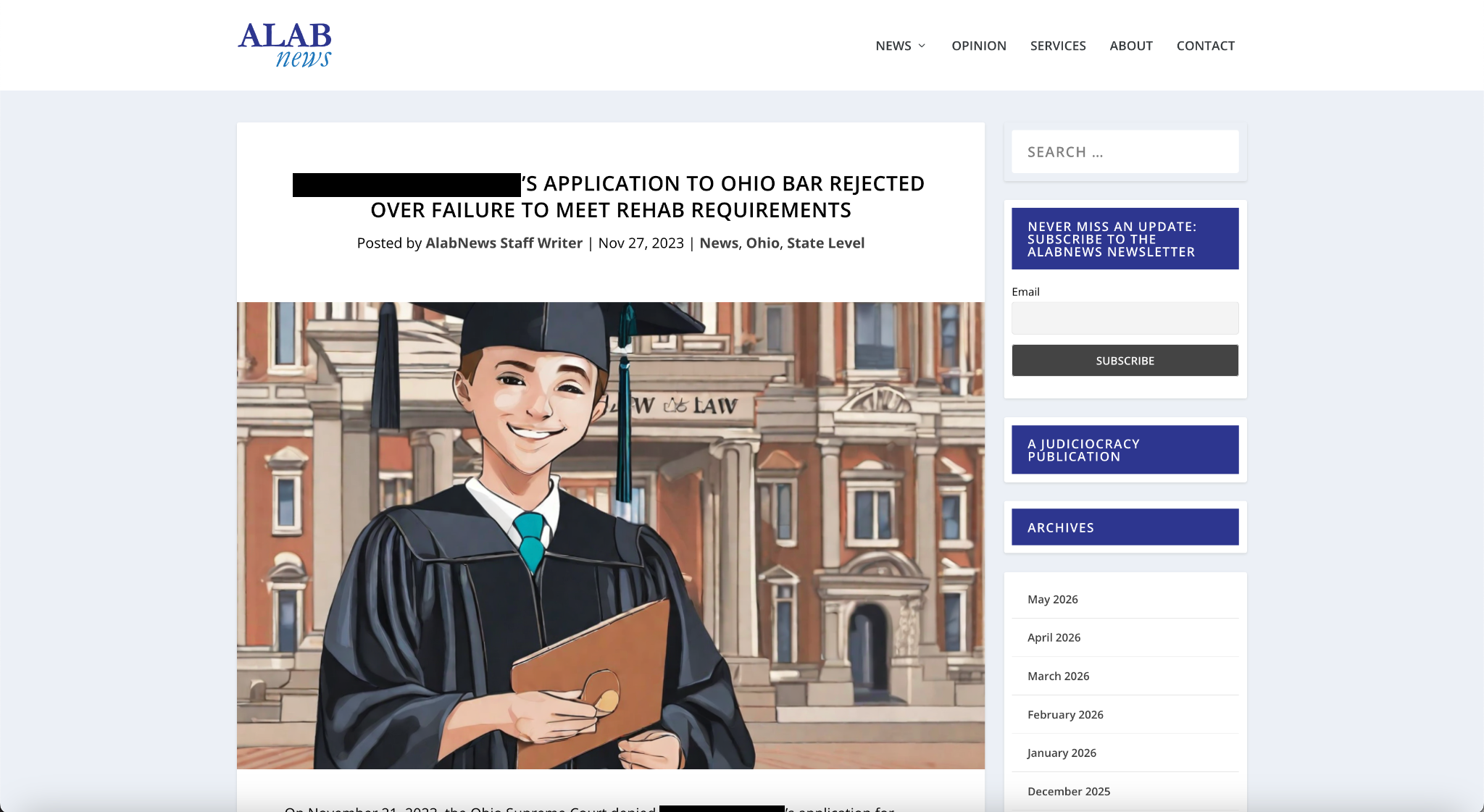
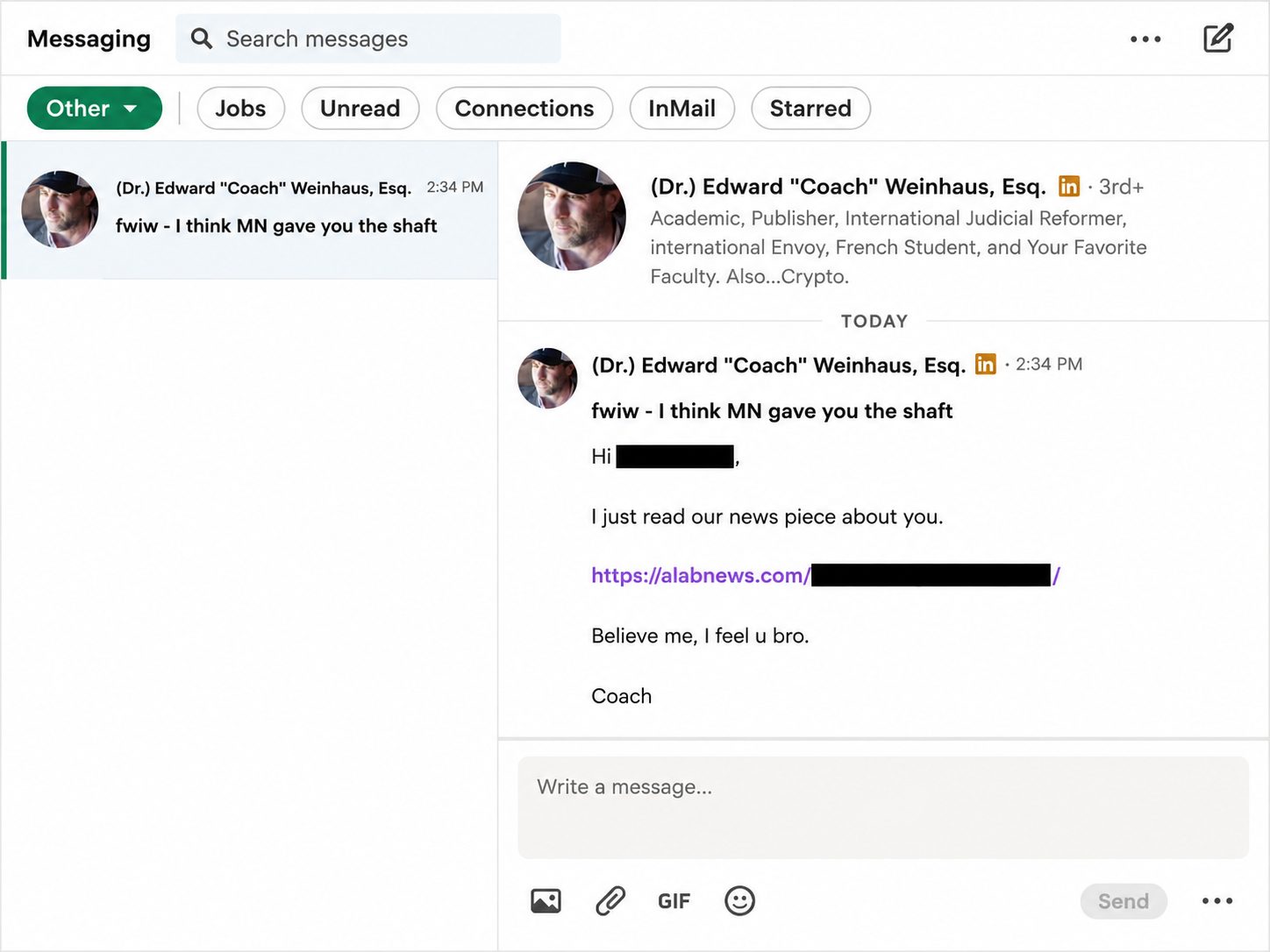
Weinhaus sent another law graduate a taunt dressed as sympathy, a LinkedIn message with the subject line “fwiw - I think MN gave you the shaft.” He had “just read our news piece about you,” he wrote, and sent the link: his own site’s hit piece, delivered personally. Then the condolences: “Believe me, I feel u bro.”
On June 2, journalist Jansen Fluegel published “It Was Available,” examining Weinhaus’s criminal harassment charges, the disciplinary complaint and his treatment of law graduates. In a June 4 email to the commission, Weinhaus declared that his sites were “likely tracking” a law graduate’s behavior “as part of a broader investigation.” He dangled more to come: “there do seem to be a lot of juicy stories available.” “I am sure the publications will get around to it.”
On June 5, Weinhaus and his colleague Adam Florek signed a seven-page threat for Judiciocracy. It named Fluegel and reached for records identifying critics’ “sources, tipsters, informants.” It told the recipient to “treat this matter as if a lawsuit has already been filed and litigation is ongoing,” and warned of sanctions and contempt. “Please govern yourself accordingly.”
The man who yearns to advocate for free speech, even abroad, has instructions for anyone who uses it on him.
On June 10, six days after he told the commission he could do three years in Maryland state prison in his sleep, a Maryland judge issued a warrant for his arrest on charges of electronic-communication harassment and harassment by a course of conduct. He also faces separate criminal stalking charges in Maryland. Sweet dreams, Coach.
Judiciocracy. ALAB News. AbusiveDiscretion. BlockTribune. DiplomaPrivilege. VowBreakers. Thirteen titles in the signature. Yet the name he shouts is Tommy’s.
A small man with a racist to look up to.